



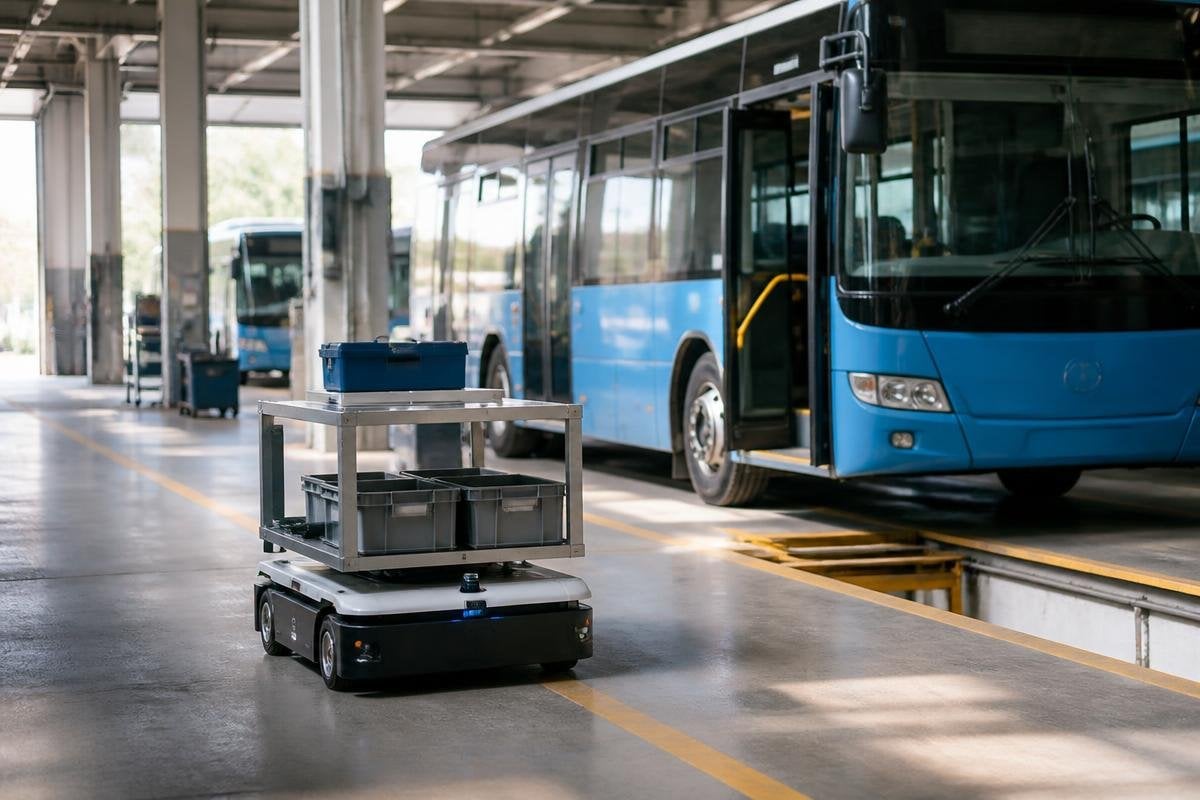
A robot moving through a bus depot faces fewer unknowns than a robot sharing a city road. That makes depots, stations, and rail yards likely places to test automation before putting passengers inside autonomous vehicles.
- Depot work comes first: Robots can move parts, inspect vehicles, or clean large areas.
- Passenger service needs more: A vehicle must read traffic, handle people, and stop safely during faults.
- The open issue is trust: Transport agencies need clear safety rules and a person who can take control.
Where robots fit first
Public transport runs on many tasks that passengers never see. A depot must move tools and spare parts, wash vehicles, check damage, charge batteries, and prepare buses or trains for service. These jobs happen in set areas with known routes, which gives an autonomous mobile robot fewer problems to solve.
One unit could carry a replacement part from a store room to a maintenance bay. Another could inspect a vehicle’s outside panels with cameras, then send images to a technician. That does not remove the need for skilled staff. It moves repetitive work away from the task that needs human judgment.
Stations offer a different set of jobs. Robots could clean floors, carry waste, check empty platforms after service, or guide people toward ticket machines. Each task would need limits around stairs, crowds, wet surfaces, and emergency exits. A machine that works well at 2 a.m. may need a different design at the afternoon peak.
What changes for passengers
The clearest passenger benefit would come from better service between trips. If a robot helps a depot worker find a part or checks a train before departure, staff may have more time to fix faults before the vehicle reaches the platform.
Autonomous shuttles could also serve short routes on private roads, airport grounds, campuses, or other areas with controlled traffic. The vehicle still needs cameras, LiDAR, maps, brakes, and a way for a remote operator to respond when its software cannot make a safe choice.
A city street is harder. Cars stop in unexpected places. Cyclists change direction. Road works move each week.
A passenger vehicle must also deal with medical incidents, lost children, blocked doors, and people who cross outside marked areas. Those events are rare, but the system must have a clear response for each one.
Those incidents make the test setting matter. Robot24 can help you compare named transit robots, trial conditions, and stated safety limits before the next section looks at what still blocks wider use.
The limits are practical
A robot does not fix a weak transport plan. It still needs charging space, safe access, software updates, spare parts, and staff who can repair it. Agencies also need to decide who owns the data from cameras and how long they keep it.
Safety rules matter more than a smooth demonstration. The transport operator must know what happens when a sensor becomes dirty, a wireless link drops, or a person enters the robot’s path. A safe stop may protect people, but a large fleet of stopped machines can also block a depot or delay service.
Jobs are part of the same decision. Automation may reduce some lifting, inspection, and cleaning work, while creating more work in repair, supervision, mapping, and safety checks. A transport agency should publish the task it plans to automate and explain how staff roles will change before buying machines.
The strongest opposing view is that public money should go to more drivers, better tracks, and shorter waits before robots. That view has force when a robot adds cost without fixing a measured service problem.
A practical test for transport agencies
Before a pilot moves beyond a depot, check these points:
- Name one task: Measure the work that causes delays, injuries, or repeated manual trips.
- Map the space: Record doors, ramps, people, vehicles, radio coverage, and emergency routes.
- Set the stop rule: Decide when the robot must stop and how a person will take control.
- Count the full cost: Include charging, repairs, training, software, insurance, and staff time.
- Publish the result: Report completed tasks, stops, faults, injuries, delays, and work left to people.
This process keeps a pilot tied to service, rather than to a machine bought for its own sake. I’d fund depot automation before driverless buses, because the work area is easier to control and the public risk is lower.
The next useful step is small: choose one depot task, set a safety measure, and run it long enough to show whether service improves without hiding the failures.